
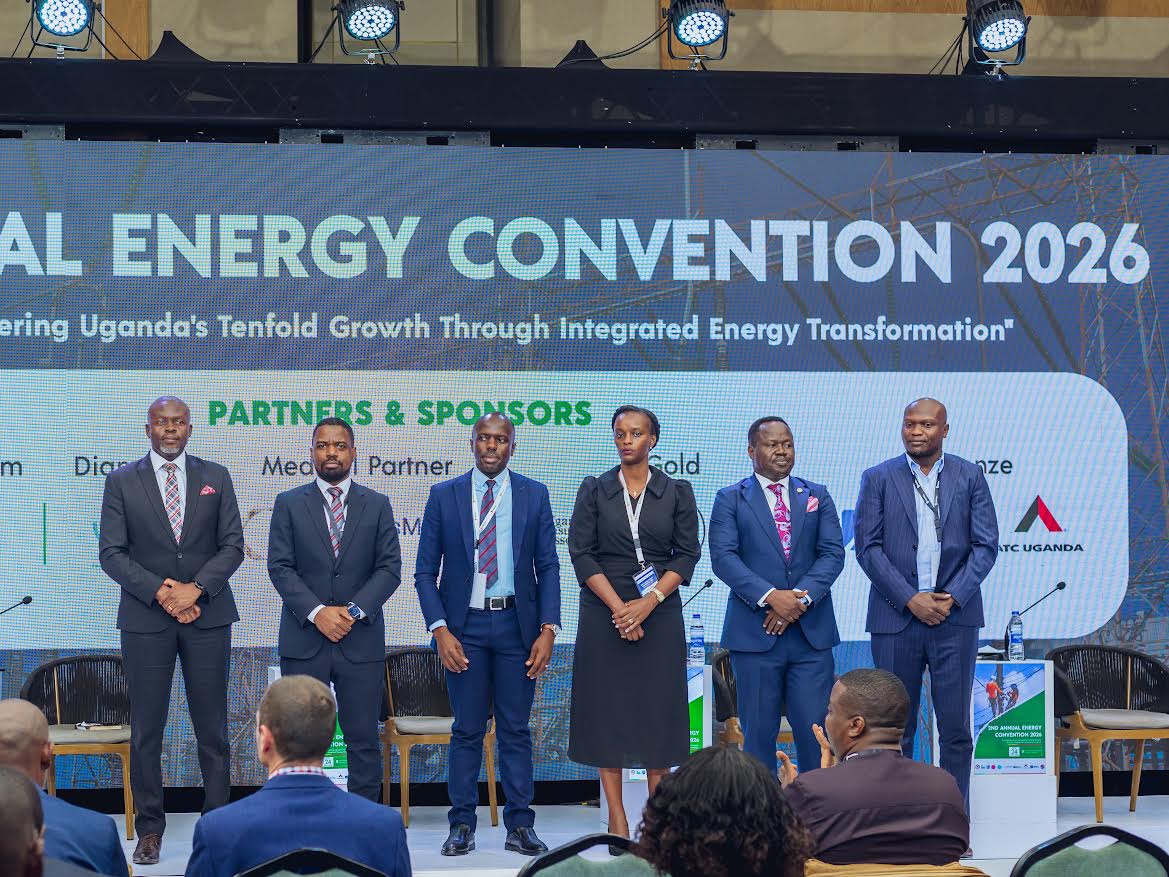
Absa Bank Uganda has reaffirmed its commitment to financing Uganda’s energy transition, calling for stronger blended finance mechanisms and bankable projects to unlock the country’s ambition of building a $500 billion economy.
Speaking during the second Energy Convention, Absa Bank Uganda Chief Financial Officer Michael Segwaya said achieving Uganda’s long-term energy goals will require more than increased public investment, emphasizing the need for financial institutions to develop sustainable financing models that attract private capital.
“Uganda’s Tenfold Growth Strategy is an ambitious but achievable target. From this year’s shs2.07 trillion allocated to the Power and Renewables sector in the 2026/27 national budget, it is clear leadership is focused in the right direction. However, as financial institutions, our role is to co-create long-term, bankable financial structures that turn ambitious masterplans into operational assets,” Segwaya said.
He highlighted Absa’s continued support across the energy value chain, pointing to its involvement in the Bujagali Hydropower Project, a $50 million five-year financing facility extended to the Uganda Electricity Distribution Company Limited (UEDCL) to connect more than 200,000 households, and a shs 11.085 billion concessional credit facility with the Uganda Energy Credit Capitalization Company (UECCC) under the Electricity Access Scale-Up Project.
Although Uganda’s installed electricity generation capacity has reached 2,098 megawatts (MW), access to electricity remains uneven. National electrification stands at about 60 percent, falling to 42.4 percent in rural areas, where more than 90 percent of households still depend on biomass for cooking and heating.
With Uganda targeting 15,420 MW by 2030 and 52,482 MW by 2040, delegates agreed that the biggest challenge is no longer electricity generation but expanding access, improving affordability, and making projects attractive to investors.
Absa Bank Uganda’s Head of Financial Institutions Group, Benard Kamatte, said the greatest barrier to attracting private investment remains project bankability.
“Our biggest bottleneck is bankability. Capital follows risk mitigation, and if we don’t have a good understanding of the technology we’re supporting, it becomes very difficult to pull capital into that space,” Kamatte said.
He noted that inadequate project preparation, including limited feasibility studies, environmental assessments and technical advisory services, continues to discourage investment in the sector.
Kamatte said Uganda’s commercial banks have already demonstrated their ability to finance major infrastructure projects, citing participation in the $5.6 billion East African Crude Oil Pipeline (EACOP) project. He argued that similar financing models can support renewable energy, mini-grid systems and battery storage if Development Finance Institutions (DFIs) provide early-stage risk mitigation.
He cited Absa’s blended finance partnership with UECCC as a practical example of how concessional funding from development partners and government can reduce financing costs. The arrangement enables participating financial institutions to cap lending rates at 15 percent per annum, making it easier to finance last-mile electricity connections, institutional solar installations and clean cooking technologies.
The convention also explored the role of carbon credit financing and green bond frameworks as emerging tools to mobilize additional private investment into Uganda’s clean energy sector.
Absa said that by strengthening project preparation, expanding blended finance solutions and enhancing local capacity to assess energy investments, the bank remains committed to financing the infrastructure needed to accelerate energy access and support Uganda’s journey towards a $500 billion economy.
